Marketing · 15 Oct 2026 · 22 min
How to get backlinks: what works, in the order to try it
Most guides to getting backlinks are a list of places to ask. The order matters more than the list: win back the links you already have, get listed where your customers look, make one thing worth linking to, then tell the people who'd use it. With numbers from a 249-source catalogue, the outreach email to send, and the shortcuts Google's spam policy names.
Most guides to getting backlinks are a long list of places to ask. Fifty tactics, a hundred, each with a screenshot. The tactics aren't the hard part. The order is.
Do them in the wrong order and you spend a month emailing people about a page nobody would link to, while the links you already have quietly point at pages that no longer exist. Do them in the right order and the early steps make the later ones easier.
If you want the background first, what a backlink is, why "dofollow" isn't a real attribute, and what a list of 249 free sources turned out to be worth, that's in backlinks in SEO. This piece is the practical part: how to get them.
1You decide
Profiles, comments, forums, directories that approve instantly
Takes minutes
Says almost nothing. Anyone can place it
2A reviewer decides
Curated directories, launch sites, awards, partner and supplier pages
Takes days to weeks, and some say no
Says someone looked and let you in
3An editor decides
Guest posts, quotes in articles, podcasts, interviews
Takes a pitch, then the work
Says a publication put its name next to yours
4Someone you never asked
Links to a tool, a dataset or an answer they found useful
Takes making the thing, then telling people
Says the most. Nobody had to be persuaded
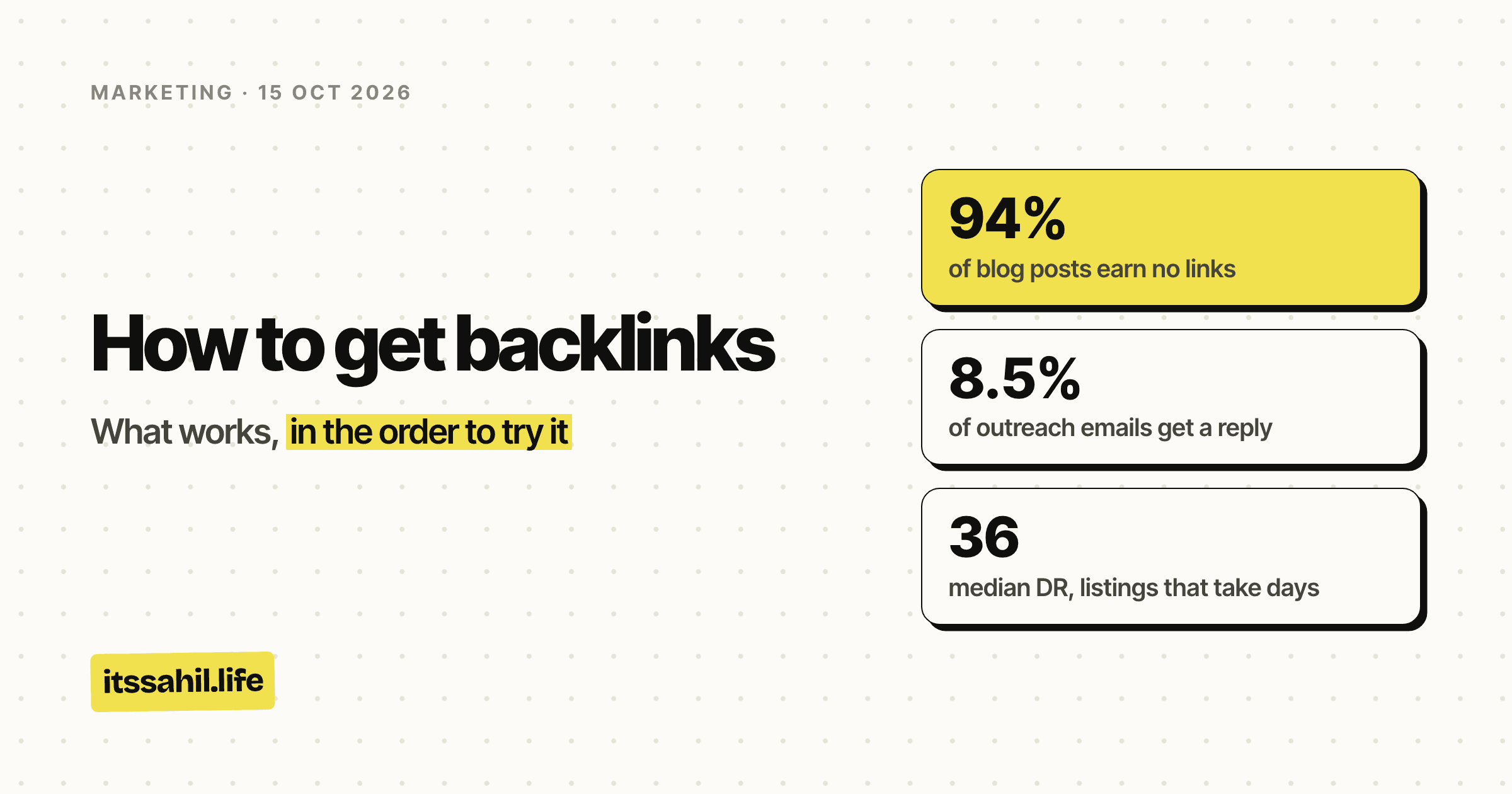
- of blog posts earn no links
- 94%
- of outreach emails get a reply
- 8.5%
- median DR, listings that take days
- 36
- median DR, listings that approve instantly
- 24
- free sources that want their badge back
- 8
The short version
- Check what already points at you. Fix links aimed at pages that no longer exist, and ask for a link where you're mentioned without one.
- Get listed where your customers already look. A handful of reviewed listings, chosen for audience, not for how many you can collect.
- Make one thing worth linking to. A free tool, data nobody else has, or the best answer to one question.
- Tell the people who'd use it. One email per person, written for them, with one follow-up.
- Earn the editorial links. Guest posts people read, quotes for journalists, podcasts.
- Skip anything that lets you place a link yourself, at volume. It's the pattern Google's spam policy is built to catch, and the links mostly count for nothing.
The rest of this post works through each step: what to do, what it costs, and what the numbers say.
Why the order matters
It helps to be clear about what Google says links are for, because it rules out most of the shortcuts. Google's own documentation is plain about it:
Google uses links as a signal when determining the relevancy of pages and to find new pages to crawl.
A signal, not the signal. Google's SEO starter guide goes further: it puts PageRank under the things it thinks you shouldn't focus on, and says it has many ranking signals, of which PageRank is just one. The same guide says links happen "naturally over time", and that you can encourage them by promoting your site.
That's the useful frame. A backlink is somebody else deciding your page is worth pointing at. The diagram above sorts links by who made that decision:
- You. Profiles, comments, directories that approve instantly. You can place these in minutes, which is exactly why they say so little.
- A reviewer. A curated directory, a launch site, an award. Someone looked and let you in.
- An editor. A guest post, a quote in an article, a podcast. A publication put its name next to yours.
- Someone you never asked. A link to a tool, a dataset or an answer they found useful. Nobody had to be persuaded.
Every step in this post is a way to climb that ladder. The steps are in the order they pay off, cheapest and surest first.
Step 1: check what you already have
Before asking anyone for anything, look at what already points at you. There are two kinds of link here that you're owed, and neither needs anyone's permission to fix.
Open the Links report
Google Search Console has a Links report, free, under Links in the sidebar. It's the only view of your backlinks that comes from Google itself. It shows:
- Top linked pages: which of your pages other sites link to most.
- Top linking sites: which sites link to you.
- Top linking text: the anchor text they use.
Know its limits before you read too much into it:
- It's a sample, not every link. Google says so on the report's help page.
- Each table stops at 1,000 rows, so a well-linked site is cut short.
- It doesn't tell you which links are nofollow.
- It can keep showing links that have since been removed.
- You can export up to 100,000 rows as a spreadsheet, split into the latest links and a wider sample.
For a second view, Ahrefs' free plan (it used to be called Ahrefs Webmaster Tools) shows up to 1,000 backlinks at once for any site you verify you own. Neither is complete. Between them you'll see most of what matters.
Fix links that point at dead pages
This is the fastest backlink you'll ever get, and most sites have a few.
- In the Links report, open Top linked pages and export the list.
- Check which of those addresses now return a 404. A page you deleted, a slug you changed, an old campaign page.
- Redirect each one, permanently, to the closest live page. A 301 or 308 redirect, not a link on an error page.
Every site that linked to the old address now links, through the redirect, to a page that exists. Nobody had to agree to anything. It's worth doing after every redesign, and every time you change a URL.
The same goes for links to the wrong version of your address. If someone
links to the http:// version, or www when you use the bare domain, a
site-wide redirect sends them where they should go. The
HTTP vs HTTPS guide covers that redirect.
Turn mentions into links
People write about things without linking to them all the time. Finding those mentions takes two free tools:
- Google Alerts, at google.com/alerts. Set an alert for your name, your brand and your product, and Google emails you when a new page mentions them.
- A search that leaves out your own site. Type your brand in quotes with
-site:and your domain, for example"itssahil" -site:itssahil.life, and read what comes back.
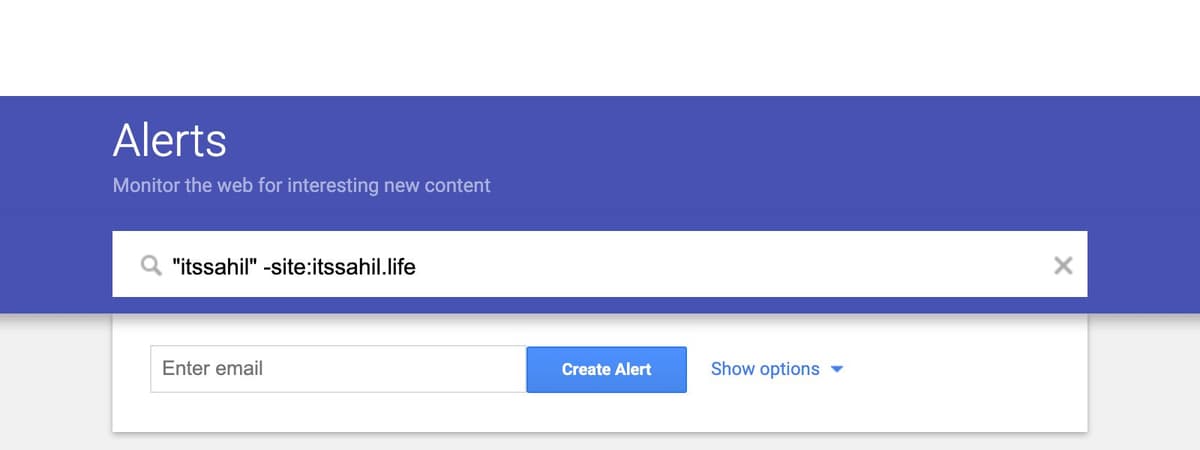
When you find a mention without a link, send one short, friendly note. Thank them for the mention and ask whether they'd add a link to the page that answers what they were writing about. Don't make it a demand, and don't follow up more than once. Plenty will say yes, because a link helps their reader too.
Step 2: get listed where your customers already look
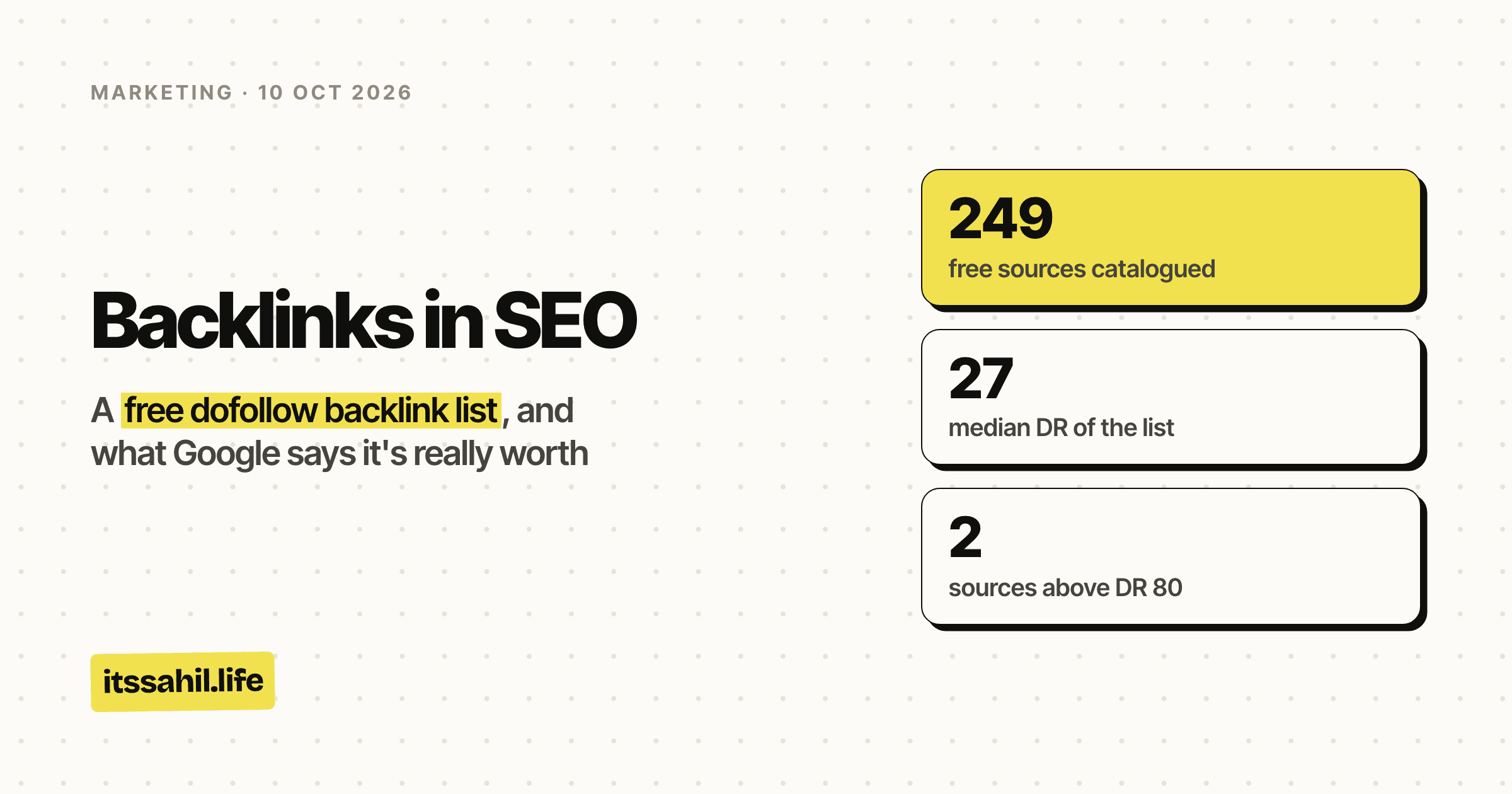
Listings are the step most people over-do. The catalogue behind the backlinks guide holds 249 free places to get a normal, followed link: directories, launch sites, communities, profile pages. Its median Domain Rating is 27, and Google's spam policy names "low-quality directory or bookmark site links" as an example of link spam.
That doesn't make every listing a waste. It makes choosing the point. Two things in the catalogue are worth knowing before you pick.
Sources that take longer to approve are stronger sites. Approval time is a rough stand-in for whether a person reviews the submission, and it tracks Domain Rating more than you'd expect:
- Sources that approve instantly have a median DR of 24.
- Sources that take three days or more have a median DR of 36.
- Of the instant ones, 41% are below DR 20.
Domain Rating is Ahrefs' estimate, not Google's, so treat it as a rough comparison rather than a grade. (The Domain Authority vs Domain Rating guide explains what it measures.) But the direction is the one you'd guess: if nobody checks, the site has less to offer.
Eight of the 249 want their badge on your site in return. For five of them, the badge is what turns a nofollow listing into a normal, followed link: put their badge, with a link back to them, on your site, and they'll follow yours. The other three tie it to a free listing or a better position. Either way, that's a link exchange with a logo on it. Google's policy names excessive link exchanges, "Link to me and I'll link to you", not every one. A single badge from a directory your customers really use isn't what it describes. A footer of twenty is.
How to choose which listings to submit to
Ask three questions of each one:
- Does a person review submissions? If it approves instantly and you've never heard of it, you're adding a row to a spreadsheet, not getting a link that says anything.
- Do your customers use it? A developer tool belongs on developer directories. A Surat bakery belongs on local listings and food guides. If the audience isn't yours, the link is all you get, and it's the weakest kind.
- Would you list here if links didn't count? If the answer is yes, a nofollow link is fine. You're there for the people.
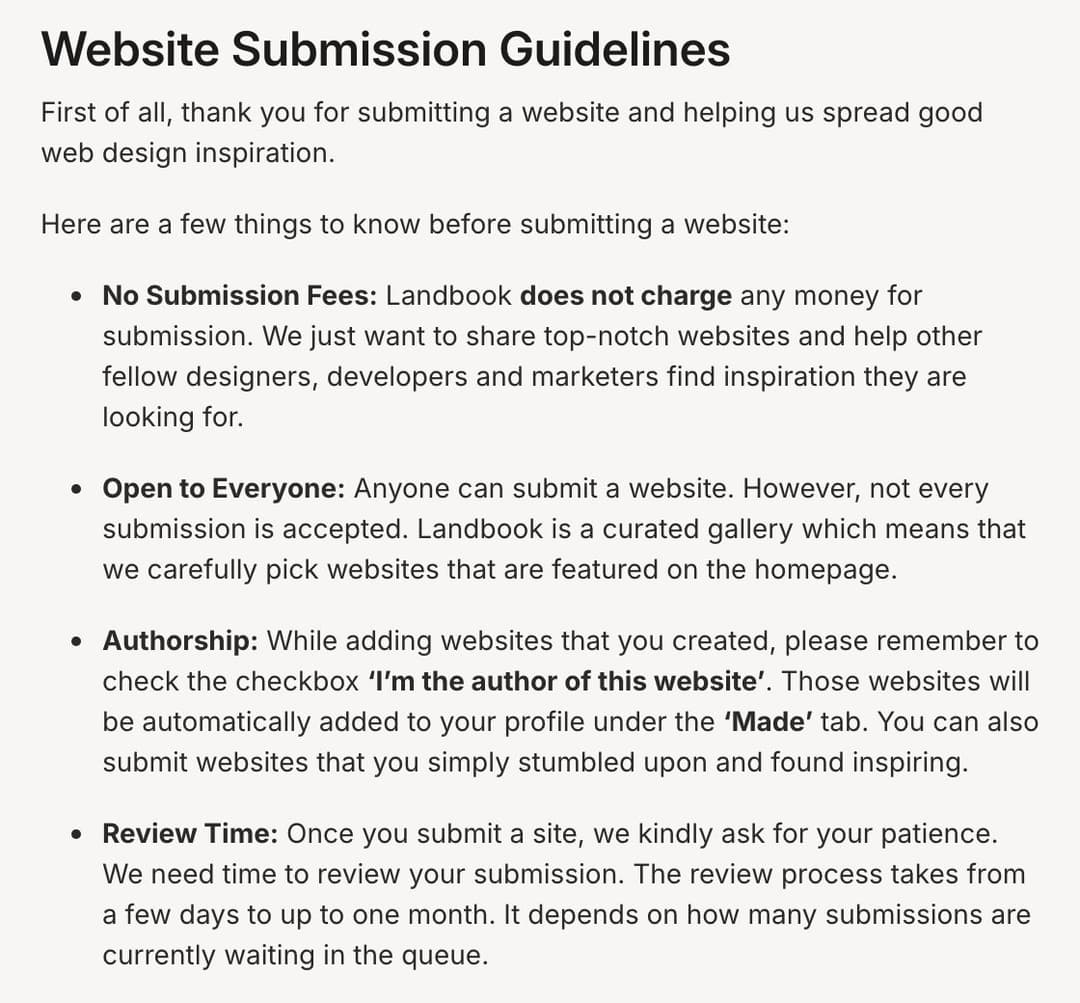
Then submit to the handful that pass. Ten good listings beat two hundred, and the ten won't sit in a spam pattern.
The kinds that usually pass, depending on what you do:
- Industry associations and professional bodies you're a member of.
- Curated launch sites and showcases in your field, the ones that reject things.
- Integration directories and app marketplaces, if your product connects to someone else's.
- Local business listings and chambers of commerce, for a local business.
- Partner, supplier and customer pages: the "who we work with" page of a company you genuinely work with.
Step 3: make one thing worth linking to
Everything so far is tidying up. This is the step that actually produces links nobody had to be asked for, and it's the one most sites skip.
The reason it matters: most content earns no links at all. Backlinko and BuzzSumo looked at 912 million blog posts in 2019 and found that 94% had no links from other websites, and only 2.2% had links from more than one site. A BuzzSumo and Moz study of a million posts in 2015 found 75% had none. Outreach for a page that's in the 94% is mostly wasted, however good the emails are.
So before any outreach, make one page that has a reason to be linked to. Four kinds reliably do.
1. A free tool
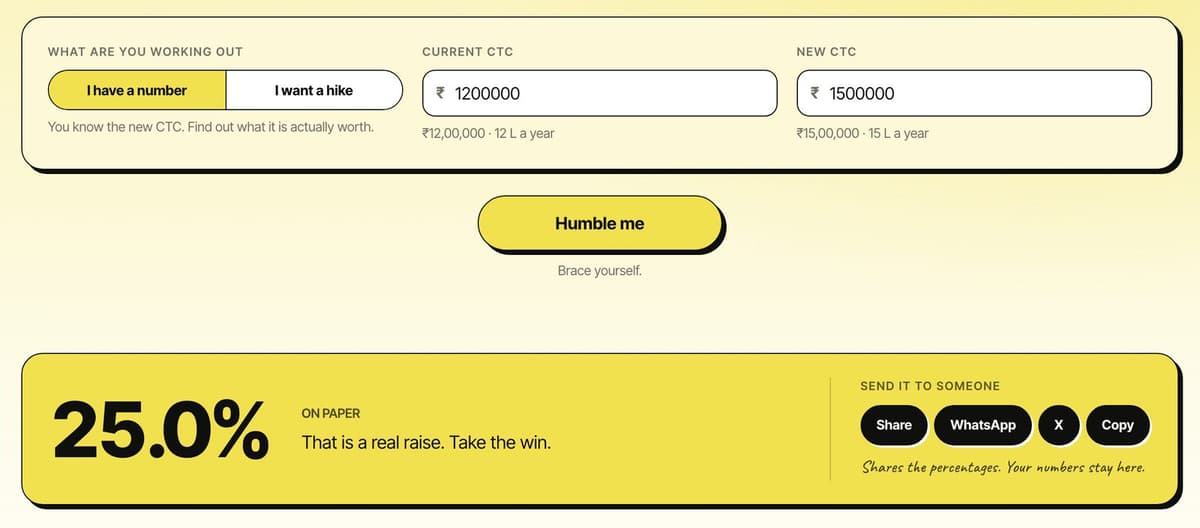
People link to tools because linking is easier than explaining. A calculator, a checker, a generator, a converter: anything that takes a question and gives back an answer.
- Answer one specific question. "How much is a 30% hike on my salary" beats "career tools".
- No sign-up, no email wall. A tool behind a form gets used less and linked less.
- Show the working. A tool that explains its answer is one people trust enough to send others to.
- Make the result shareable. A link that reopens the same result gives people something to paste.
This site has two, a salary hike calculator and a numerology name calculator, built on exactly this reasoning. A tool doesn't need to be clever. It needs to save someone five minutes.
2. Data nobody else has
Original data is the most linkable thing most people can make, and almost nobody makes it, because it's work. Anyone who wants to cite the number has to cite you.
- Count something people argue about. Not a survey of everything, one question with a number for an answer.
- Use what you can collect in a weekend. Your own records, public pages, a sample you check by hand.
- Publish the method and the raw numbers, so someone citing it can trust it.
- Lead with one quotable figure. Writers link to the number, not to the whole study.
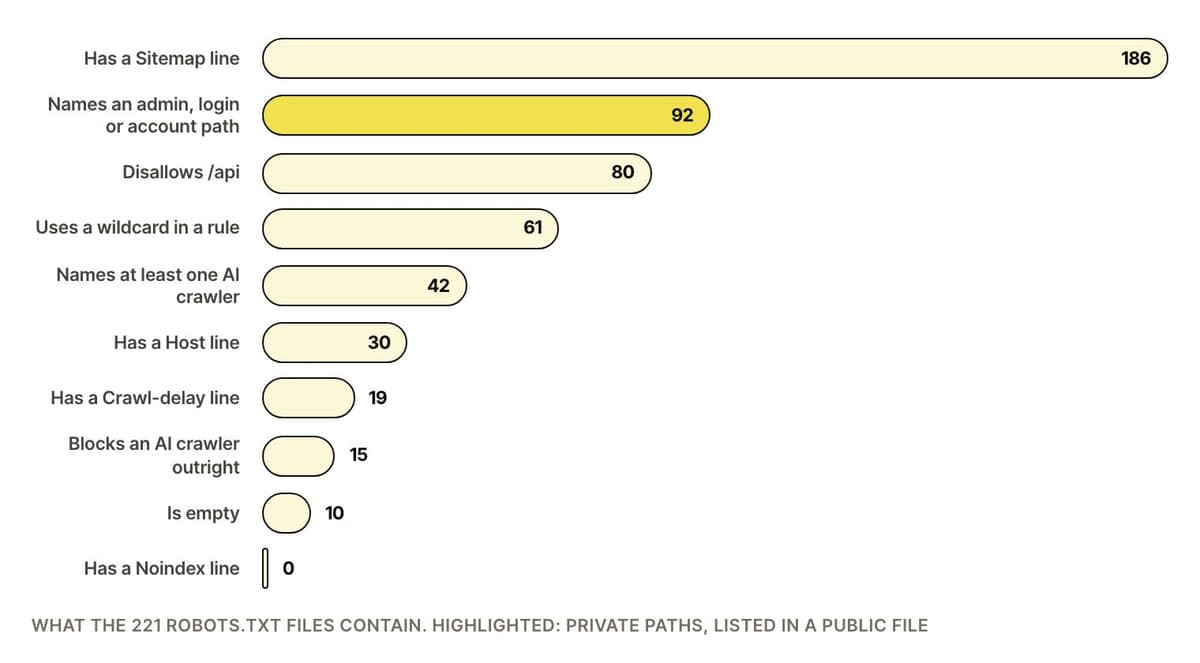
Two posts on this site do this on a small scale. The robots.txt guide reads the robots.txt files of 221 real sites, and the free vs paid keyword tools post counts what 27 autocomplete searches turned up. Both have figures nobody else publishes.
3. The best answer to one question
Not the longest answer. The one someone would rather link to than rewrite.
- Pick a question people keep having to explain, the kind that comes up in forums and support emails.
- Answer it in the first paragraph, then go deeper for those who need it.
- Add the thing other answers don't have: a diagram, a worked example, a number, a clear "it depends, and here's on what".
The same Backlinko study found "why" and "what" posts earned more links than how-to posts and videos, and list posts came last. That fits: people link to explanations, and they rarely link to lists.
4. A template or download
A spreadsheet, a checklist, a template people would otherwise build themselves. These get linked from roundups and resource pages.
There's a trade-off worth knowing. A download behind an email form, like the catalogue on this site, collects subscribers, but people tend to be less willing to link to something their readers have to sign up for. If links are the goal, leave it open.
Step 4: tell the people who'd use it
A good page still needs people to find it. Outreach is just telling the specific people who'd find it useful, one at a time. Done well it isn't spam. Done at scale with a template it is, and the numbers show it.
What reply rates look like
- 8.5%. Backlinko and Pitchbox analysed 12 million outreach emails in 2019. That was the share that got any response at all, not a yes.
- About 12%. BuzzStream's analysis of more than 12,000 campaigns found a median reply rate around there, with the top 5% of campaigns above 40%.
- 4.5% overall, 13% for digital PR. Hunter's study of 31 million cold emails sent in 2025 found the average reply rate, and a much higher one for link building and digital PR pitches.
Plan on that. If you email 20 people about a page that genuinely helps them, two replies and one link is a normal result. Brian Dean's write-up of his skyscraper technique, the best-known version of this, reported 17 links from 160 emails, about 11%, and that was the method's showcase.
The same studies agree on what moves the number:
- Follow up once. In the Backlinko data, one follow-up lifted replies by 65.8%. Hunter found three emails in total worked best.
- Personalise properly. BuzzStream found that personalisation relevant to the recipient lifted reply rates, while fake personalisation, a name dropped into a template, lowered them slightly.
- Write to a person, not an inbox. A named editor beats contact@.
Who to email
The best prospects are people who have already linked to something like yours. They've shown they link out on this subject.
- Pages linking to a similar resource. Put a comparable page into a backlink checker. Ahrefs' free checker shows the top 100 backlinks of any page. For more, you need a paid tool, and the free vs paid tools post covers when that's worth it.
- Resource pages. Search for lists that exist to link out:
| Search | What it finds |
|---|---|
intitle:resources "salary negotiation" |
Pages titled as resource lists on your topic |
inurl:links "salary negotiation" |
Older link pages, often on universities and associations |
"useful tools" "salary hike" |
Roundups of tools in your area |
"salary negotiation" -site:yourdomain.com |
Recent writing on the topic, for writers to contact |
- Writers who covered the problem recently. Someone who wrote about it last month may update the piece, or write about it again.
- Newsletters in your field. Editors need something to put in next week's issue.
The email
Short, specific, and about their page, not yours.
What makes the better version work:
- It proves you read their page, with a detail only a reader would know.
- It offers something for their readers, not a favour for you.
- It asks for one specific thing, in one specific place.
- It gives them an easy way out, which makes yes easier too.
And what to leave out: never offer money, a product or a link back in exchange for a followed link. That's the buying-links line in Google's spam policy, whatever the email calls it.
Step 5: earn the editorial links
These take the most effort per link, and they're worth the most, because a publication decided to put its name next to yours.
Guest posts people actually read
Guest posting got a bad name from people doing it at scale. Google's webspam team set out where the line is in a 2017 post. It says Google does not discourage guest articles "in the cases when they inform users, educate another site's audience", among other good reasons. It does treat them as a link scheme when the main intent is building links at scale, and names "stuffing keyword-rich links to your site in your articles" as one of the warning signs.
So:
- Choose publications by audience. Would your customers read it anyway? That's the test, not its Domain Rating.
- Read a dozen of their recent pieces before you pitch. Pitch two or three specific ideas that fit what they publish.
- Write it better than you'd write for your own blog. It's going in front of somebody else's readers.
- Link once, where it helps. To a page that adds to the article, with plain words as the anchor, not a keyword you're trying to rank for.
- Don't mind nofollow. Many publications nofollow guest authors' links. You're there for the readers.
Signs a site isn't worth it: a "write for us" page with a price list, "guest post packages", or a site that publishes anything on any topic. That's the advertorial line in the spam policy, links that pass ranking credit in exchange for payment.
Be the source journalists quote
Journalists need experts every day, and several services connect them:
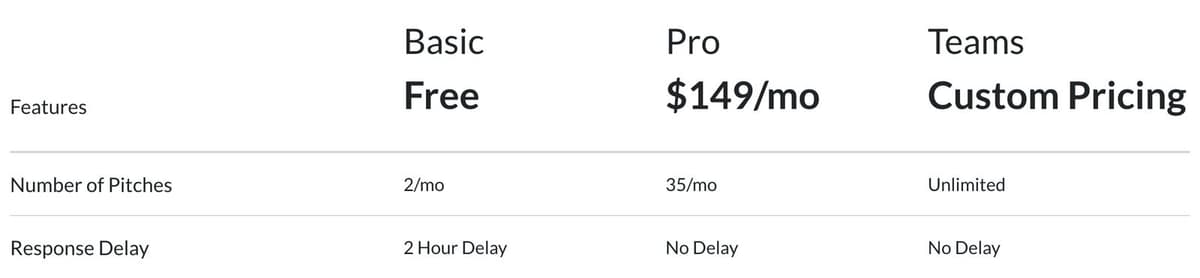
- Qwoted matches reporters with sources. Its basic plan is free, with two pitches a month.
- SourceBottle lets you set up a free expert profile and answer journalists' call-outs.
- HARO, the original, closed in December 2024. Featured.com bought it and relaunched it as a free newsletter in April 2025. Check it's still running before you rely on it.
Answering well is a skill:
- Answer fast. Requests come with deadlines, and early answers are read first.
- Answer the actual question, in the first line.
- Give them something quotable: a number, a specific example, a clear opinion.
- Say why you're qualified, in one line.
- Keep it short. A paragraph or two they can lift, not an essay.
If you have original data from step 3, pitch it straight to journalists who cover your field. A new number is news. A product isn't.
Podcasts and interviews
Podcast show notes often link to the guest. Smaller shows in your field are easier to get on and their listeners are closer to your audience. Pitch the episode, not yourself: the one story or argument you'd bring.
Smaller links that add up
None of these is a strategy on its own. Together, over a year, they're a steady trickle of links that are real.
- Testimonials for tools you pay for. Vendors publish customer stories and often link to the customer. Offer one for software you genuinely use.
- Partners and suppliers. If you work with a company, being on their "who we work with" page is ordinary business.
- Events and talks. Speaker pages link to speakers. Meetups list their hosts.
- Communities. Answering questions where your subject is discussed. Community sites usually mark links nofollow or ugc, and the point is the people. Some of them write about you later, with a link.
- Sponsorships. Fine, as long as the link is marked
rel="sponsored". Google's policy says paid links for advertising and sponsorship are a normal part of the web when they're qualified that way.
Broken link building
A variation on outreach. Find a page that links to a resource that has disappeared, and offer yours as the replacement.
- Find resource pages on your topic, using the searches above.
- Check their outbound links for ones that return errors. A link checker or a browser extension does this in seconds.
- If you have a page that replaces what's gone, email the owner: here's the dead link, here's where it is on your page, here's something that does the same job.
It works because you're fixing a problem for them first. It's slow, and you need a page that's a genuine replacement, which loops back to step 3.
What not to do
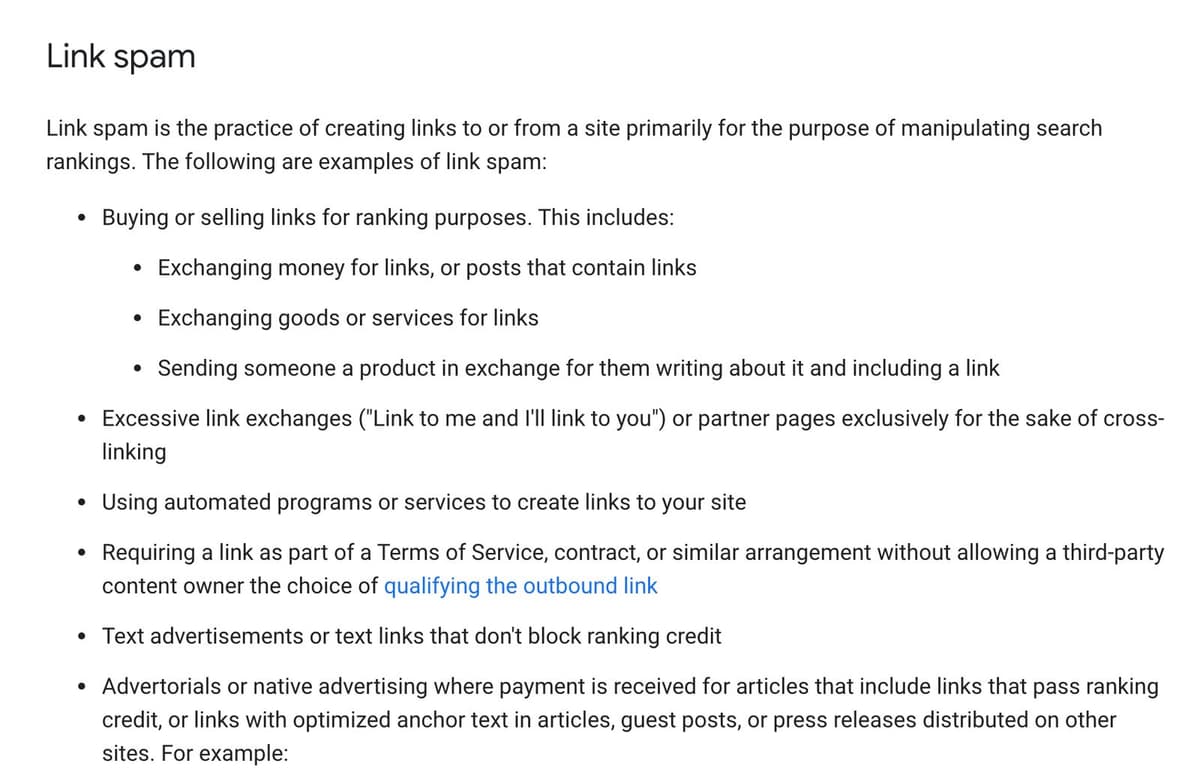
Every shortcut has the same problem: if you can place the link yourself, so can everyone, so the link says nothing. Google's spam policy lists these as link spam, among others:
- Buying or selling links that pass ranking credit, including paying in goods, services or free products.
- Excessive link exchanges and partner pages that exist only to cross-link.
- Automated programs or services that create links to your site.
- Advertorials and paid guest posts with links that pass ranking credit, or optimised anchor text in guest posts and press releases.
- Low-quality directory and bookmark links, which is most of the free catalogue.
- Links hidden in widgets distributed across many sites.
- Footer and template links spread across many sites, like a credit link on every client site an agency builds.
- Forum comments with optimised links in the post or the signature.
What usually happens to these links isn't a penalty. Since its December 2022 link spam update, Google says its SpamBrain system detects sites buying links and sites selling them, and neutralises the links, so any credit they would have passed is simply lost. You pay, in money or time, for nothing. Manual actions for link schemes still exist too, so the risk isn't zero.
That's also why the disavow tool isn't something most sites need. Google's own help page says "most sites will not need to use this tool", and that it can harm a site if used wrongly. If spammy sites link to you without your asking, Google typically ignores those links.
How long it takes, and how to track it
There's no honest timeline, but there are honest expectations:
- Reclaimed links: within days of the redirect.
- Reviewed listings: days to weeks, and some will say no.
- Outreach: replies within a week or two, links trickle in after that.
- A tool or a study: months, and then it keeps going, for as long as it's useful.
Keep a simple sheet, one row per link you go after:
| Column | Why |
|---|---|
| Date | So you can see what's working over months, not days |
| Your page | Which page the link points to |
| Their page | Where the link is, or where you asked for it |
| How | Reclaimed, listing, outreach, guest post, quote, unasked |
| Status | Asked, followed up, live, declined |
| Type | Followed, nofollow, sponsored |
Then check the Links report once a month, not once a day. And judge the work by what links are for: referral visits from the pages that link to you, and whether the linked page climbs for the searches it's meant to answer.
A first month, in order
If you're starting from nothing, this is a reasonable first month.
Week 1: what you already have
- Open the Search Console Links report and export top linked pages.
- Redirect every linked address that returns a 404.
- Set Google Alerts for your name and brand, and search for unlinked mentions.
Week 2: listings
- Shortlist ten listings that pass the three questions.
- Submit to them properly: real descriptions, real screenshots.
Weeks 3 and 4: one thing worth linking to
- Pick one: a small tool, a small dataset, or the best answer to one question in your field.
- Build it, and make it better than anything already ranking for it.
After that: tell people, steadily
- Find 20 people who've linked to something similar.
- Write each one an email about their page.
- Follow up once. Then make the next thing.
Where this leaves you
The reliable ways to get backlinks are all slower than the unreliable ones. That's not bad luck, it's how links work: a link is worth something because someone else decided to give it, and the faster you can get one on your own, the less it says.
So climb the ladder in order. Take back the links you're owed. Get listed in the few places your customers look. Make one thing that deserves a link, and tell the people it would help. Then make the next one.