Marketing · 10 Oct 2026 · 9 min
Backlinks in SEO: what Google actually says, and what a free dofollow list is really worth
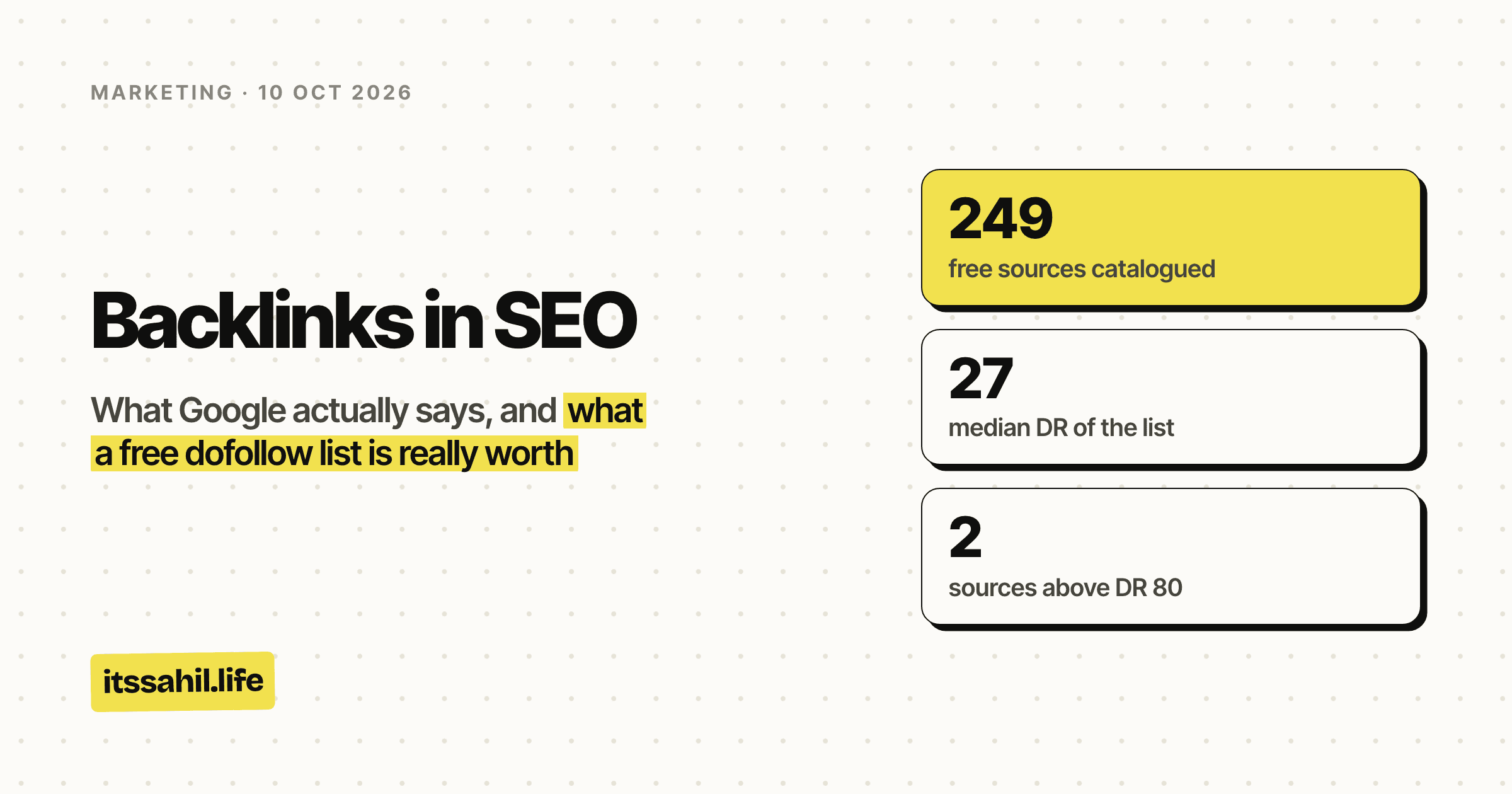
I catalogued 249 places that hand out free dofollow links. The median was DR 27, two were above DR 80, and Google's spam policy names most of the category outright. Here is the whole picture, with the numbers.
Nearly every guide to backlinks starts in the same place, with a long list of places you can go and get one. I want to start somewhere less comfortable, because I spent a while building exactly that list and the numbers in it were not what I expected.
I have been collecting free dofollow sources for a side project. Directories, launch platforms, profile pages, communities, anywhere that hands out a normal link without asking for money. The list got to 249 entries. Then I actually looked at the distribution.
The median Domain Rating was 27. Two sources out of 249 were above DR 80. Eighty of them were below DR 20.
That is the real shape of the free backlink economy, and it is worth knowing before you spend a weekend submitting to all of it.
- free sources catalogued
- 249
- median DR of the list
- 27
- sources above DR 80
- 2
- sources below DR 20
- 80
- nofollow became a hint
- 2019
- times Google writes dofollow
- 0
The word everyone uses does not exist
Start with the vocabulary, because it causes more confusion than anything else in this topic.
There is no such thing as a dofollow link. It is not an attribute, it is not in the HTML spec, and it does not appear anywhere in Google's documentation. I checked the page where Google explains how to qualify outbound links, last updated in December 2025, and the word is simply not there.
What exists is the absence of an attribute. A plain link looks like this:
<a href="https://example.com">a normal link</a>
That is what people mean by dofollow. It is just a link. The interesting cases are the three values Google does recognise, and each one says something different:
| Attribute | What it tells Google |
|---|---|
rel="sponsored" |
This is an advertisement or a paid placement |
rel="ugc" |
Somebody else put this here, in a comment or a forum post |
rel="nofollow" |
I would rather you did not associate my site with this one |
You can combine them, so rel="ugc nofollow" is valid and means both things.
The one piece of history worth carrying around: in 2019 Google said it would start treating nofollow as a hint rather than a strict instruction. Before that, nofollow meant ignore this link. After it, nofollow means Google will decide. It has never published how often it decides to use them, and its current documentation does not say whether nofollow links affect ranking either way.
So the honest answer on nofollow links is that they are worth having and impossible to count on. Which is also, roughly, the honest answer on backlinks in general.
What a backlink is actually doing
The underlying idea is old and fairly sensible. If a page is worth reading, other people tend to mention it. Counting those mentions gives a search engine a rough signal of whether a page deserves to be surfaced, independent of what the page says about itself.
That is the whole mechanism. A link is a vote that someone cast with their own site's credibility.
Which immediately tells you what a good link looks like. It comes from a page that a real person might land on, it sits in content rather than a footer, and the site giving it had some reason to give it. A link that fails all three is not really a vote. It is a formality.
The 249, in detail
Here is the catalogue broken down. These are places offering a normal, unqualified link, free, to anyone who submits.
Eighty seven percent of the list sits below DR 60. The two at the top are DEV Community at DR 91, which is a genuine developer publication where the link comes from writing an actual post, and Awwwards at DR 89, which reviews submissions and rejects most of them.
Notice what those two have in common. Neither is a directory. One is a place you publish, the other is a place you get judged. The effort is the filter, and the filter is why the link is worth anything.
Further down the list the pattern reverses. Twenty eight of the 249 approve instantly, with no review at all. If nobody is checking, then nobody is vouching, and a link nobody vouched for is doing very little work.
Timing is its own mess.
A hundred and thirty of the 249 do not state a turnaround anywhere. If you are planning a campaign around this list, most of it will not tell you when, or whether, anything is going to happen.
The part most guides leave out
Google publishes a spam policy. The link spam section was last updated on the twenty eighth of August 2026, and it lists the practices that count as a link scheme. One line on that list:
Low-quality directory or bookmark site links
That is the category. Not an edge case within it, the category itself, named in the policy as an example of link spam.
I am not going to pretend this does not apply to most of what I collected. It does. A list of 249 places that give away links without review is a fairly precise description of the thing the policy is pointing at.
A few other lines from the same section are worth knowing, because they come up constantly:
- Buying or selling links for ranking purposes. Including goods or services, not just money, and including sending someone a product in exchange for a write-up with a link.
- Excessive link exchanges, or pages that exist only for cross-linking. Note the word excessive. Two sites in the same field linking to each other because it made sense is not what this is about.
- Widely distributed links in footers or templates. This is the one that catches agencies who put a credit link on every client site they build.
- Forum comments with optimised links in the post or the signature.
- Advertorials paid for with links that pass ranking credit, or with optimised anchor text in guest posts and press releases.
On that last point, Google is clearer than people expect. The policy says
outright that buying and selling links is a normal part of the economy of the
web for advertising and sponsorship, and that such links are fine as long as
they carry rel="nofollow" or rel="sponsored". The money is not the problem.
The ranking credit is.
So is the list useless
No, and this is where I want to be careful, because the honest position is more boring than either extreme.
A directory listing is not automatically spam. Being listed somewhere relevant, where people genuinely look for things like yours, is ordinary business. If you make a developer tool, being on a developer tool index is where your customers are. The link is almost beside the point.
What the policy describes is the volume play. Two hundred submissions in a weekend, to anywhere that will have you, chosen by whether the link is free rather than whether the audience is yours. That is a pattern, and patterns are exactly what spam systems are built to find.
My own rule, after building the list and then looking at it properly:
- If a human reviews the submission, it is probably worth submitting to.
- If the site has an audience that overlaps with yours, it is worth submitting to even if the link is nofollow.
- If it approves instantly and you have never heard of it, you are collecting entries in a spreadsheet, not building anything.
That last one took me 249 rows to arrive at.
What actually earns links
The uncomfortable thing about backlinks is that the reliable methods are all slower than the unreliable ones.
Build a tool and give it away. A calculator that answers a specific question, free, no signup, no email wall. People link to tools because linking is easier than explaining. Two of the pages on this site are calculators for exactly this reason, and they cost me a weekend each.
Publish data nobody else has. This post is a small example. The numbers in it exist because I counted them, which means anyone who wants to cite the median DR of a free backlink list has one place to go. Original data is the single most linkable thing most people can produce, and almost nobody produces it because it is work.
Answer a question properly. Not comprehensively, properly. Most content on any given topic is padded restatement of the same four points. A page that actually resolves the question gets linked by the next person who had to look it up.
Be somewhere real. Write for a publication in your field. Turn up in communities where your subject is discussed. These produce fewer links than a submission spree and every one of them is worth more.
The common thread is that the link is a side effect. Nothing on that list is a way to get links. They are ways to be worth linking to, which is a slower and considerably more reliable thing.
How to check what you already have
Before chasing new links, look at what points at you now. Google Search Console has a Links report, it is free, and it is the only source that is actually Google's own view of your backlink profile. Everything else is a third party crawling the web and estimating.
On which note, a word about the metrics. Domain Rating is Ahrefs. Domain Authority is Moz. Authority Score is Semrush. None of them is a Google metric, Google does not use any of them, and a site's score can move because the tool changed its model rather than because anything happened to the site. I used DR throughout this post because it is the number my catalogue recorded and it is useful for rough comparison. It is not a grade.
Where this leaves you
If you came here for a list of places to get free backlinks, I have one, and I have told you what it is worth. The median entry is DR 27, most of it approves without review, and Google's spam policy names the category.
The two sources at the top of my list are both places where you have to do something first. Write a real post. Submit work that might get rejected. That is not a coincidence, and it is most of what there is to know about backlinks in SEO.
The rest is a spreadsheet.